
Swetaleena Dash
Researcher & Writer


#1
Quantifying the high resolution seasonal emission of air pollutants from crop residue burning in India
Crop residue burning is a major environmental issue in India, causing a significant deterioration of air quality. A comprehensive emission inventory has been created for the year 2018, providing a high-resolution, spatially resolved map of major pollutants released from crop residue burning. The inventory includes emissions of PM2.5, PM10, BC and OC, CO, NOx, SO2, VOC, CH4, and CO2, with the winter months contributing around 50% of the total emissions, followed by summer at approximately 48%. Rice, wheat, maize, and sugarcane are responsible for around 90% of the PM10 load in the country. The gridded emissions inventory is expected to serve as a crucial input to regional atmospheric chemistry transport models, enabling better quantification of the impact of crop residue burning on air quality across India.
Read the complete article in the below link.

#2
High-Resolution Emission Inventory of Major Air Pollutants of Mega City Delhi (2018)
A mega emission inventory campaign led by the Indian Institute of Tropical Meteorology (IITM) Pune, involving around 150 students under the supervision of a group of scientists, has successfully mapped all possible local sources of air pollution in Delhi and its surrounding regions. With over 37,500 hours of work, the campaign generated major primary data, validated uncertainty, and collected available secondary data. The final result is a high-resolution emission inventory of Delhi and its fringe area for eight important air pollutants. The campaign estimated emissions from 26 different sources of pollution and was examined and reported by us, a group of experts and researchers from Utkal University, Bhubneshwar, School of Planning and Architecture, Environmental Information System (ENVIS), Resource Partners of MoEFCC, CPCB, IMD, and DPCC. This is a significant achievement in the battle against air pollution and provides valuable data to develop strategies to mitigate the harmful effects of air pollution in the region.
Read the complete article in the below link.

#3
Municipal Solid Waste and Air Pollution in India: An overview
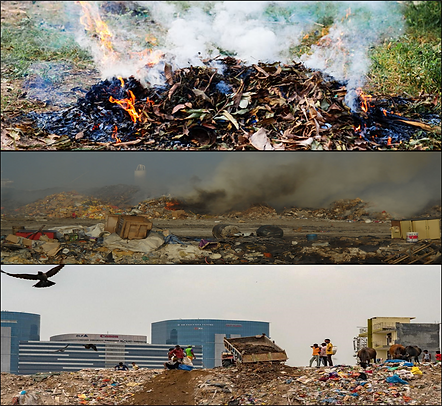
Poor waste segregation at the source exacerbates the waste management issues in India. Cities such as Delhi, Mumbai, and Bangalore have large dumping sites like Okhla, Deonar, and Mavallipura, where over a thousand tons of waste are received daily. Mismanagement of these sites often results in a significant amount of clutter, leading to improper burning and increased emissions. Studies suggest that solid waste segregation and reuse are not only the most commonly practiced methods of municipal solid waste management but also the most cost-effective and environmentally friendly. Due to the extremely low calorific value and high moisture content of the MSW, as well as high population densities and poor management services for collection and disposal, waste is often burned in the open, mainly at collection and disposal sites. As a result of a lack of proper collection processes, household waste is typically burned on-site, adding to the bulk of emissions. The article showcases an insightful scenario of the status of India today.
Read the complete article in the below link.
#4
"Hot and Hazy”
Exploring the Link Between Air Pollution and Urban Heat Islands in Indian Cities FAQs
The Urban Heat Island (UHI) effect is a phenomenon where urban areas experience significantly higher temperatures than surrounding rural areas. This is due to the absorption and retention of heat in man-made materials such as asphalt, concrete, and buildings, which replace natural vegetation and water bodies that otherwise help regulate temperatures. The UHI effect can lead to various negative impacts on human health, including heat-related illnesses and increased air pollution levels. Additionally, the UHI effect can exacerbate greenhouse gas emissions, primarily through increased energy consumption for cooling and transportation in urban areas. The use of air conditioners and cooling systems, along with increased demand for transportation, results in higher energy consumption and consequently, higher emissions. As such, mitigating the UHI effect is crucial in reducing greenhouse gas emissions and promoting sustainable urban development.
Read the complete article in the below link.


About Swetaleena Dash
Hey there! I'm Swetaleena - a quirky researcher and writer from India. As a climate science researcher and avid writer, I offer a fresh perspective and a wealth of knowledge to any project. My passion for the environment, combined with my research and writing skills, make me an asset to any organization. I am confident that I can help your business grow by collaborating to achieve a profitable and sustainable future.
As a climate researcher with sustainability expertise, I can help your business reduce its carbon footprint and adopt eco-friendly practices. With my engaging and strong writing style, I can also communicate your sustainability efforts to attract environmentally conscious customers to make a more sustainable future.
So, if you're in need of a wordsmith with a flair for research, look no further than yours truly. Check out my portfolio and let's create some magic together!